

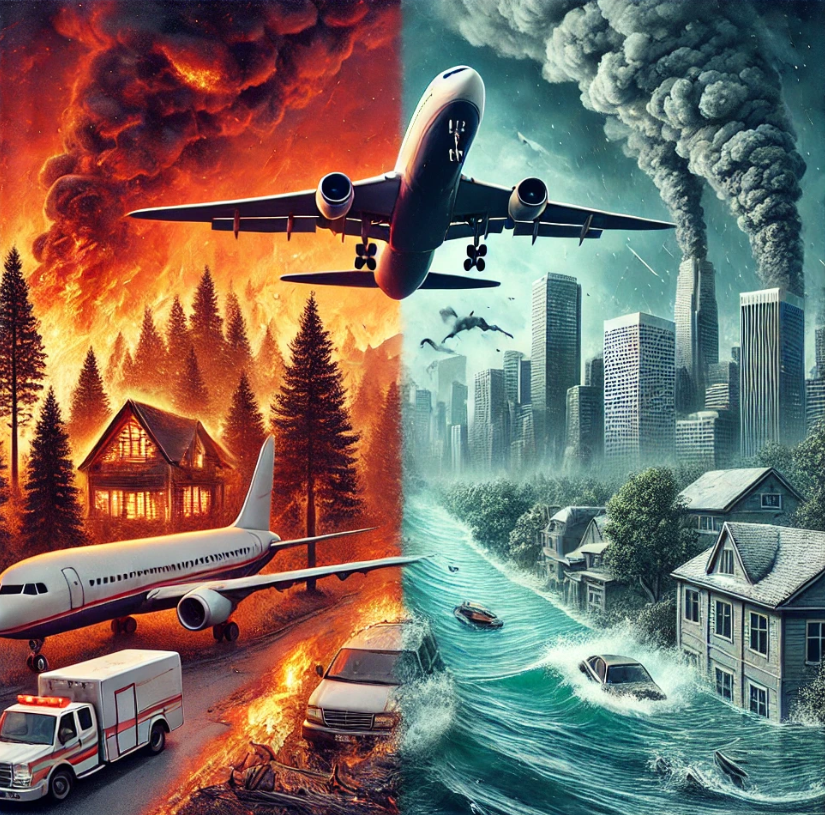
Disasters In the News
Disasters have been big news the past month. The devastating California wildfires were followed by the District of Columbia plane-helicopter collision, and then the Philadelphia medical-jet crash. The fires killed 29 people, destroyed nearly 17,000 structures, and forced tens of thousands from their homes. The DC crash (the first major US air “accident” in 16 years), killed 64 passengers and crew, plus three in the military helicopter. The med-jet crash killed six in the plane and another on the ground and burned some neighborhood houses. At first glance, we might characterize the first as “natural disaster,” the second as “human error,” the third as possible mechanical failure. But my bookshelf holds the title There Is No Such Thing as a Natural Disaster (Chester Hartman and Gregory D. Squires. Routledge. C 2006). And extrapolating, it seems all three types contain backstories of short-term decisions that can lead to devastating varieties of human error, before, during and after.
Family and Location
My siblings and I came late to disaster awareness. We grew up with relatively mild weather in a valley in New York State’s southern tier. But we’ve all ended up living in or near disaster-prone areas—hurricanes, earthquakes, wildfire territories. My brother is in southern California close to San Diego. My sister was in Berkeley near San Francisco, then moved to NYC and lived there till her death. I live in southern Louisiana just outside New Orleans. We trade mutual check-in texts when big events occur nearby. My brother took good advice and avoided risky cliff-top and water-view locations. In NYC, my sister, after Superstorm Sandy, described floodwaters sloshing behind plate glass windows, so stretches of lower Manhattan looked like a series of aquaria. An artist, she told of galleries losing inventory stored in their basements to flooding. I traded tales of Louisiana banks putting their computer systems in basements that Katrina flooded (2005).
Failing to Plan, Planning to Fail?
My husband, growing up in New Orleans, experienced hurricanes and flooding early and often. He later became the engineer of a coastal parish (county) outside the city. I worked for the same local government, and when we first met, noticed the slogan he’d posted over his desk. “Your failure to plan does not equal my emergency.” But of course, big problems, often already in crisis mode, landed on his desk. Humans often procrastinate, especially with what are called low-probability, high-impact, events. Call this “disaster amnesia,” amplified by budget constraints. “…And just as individuals tend to ignore disasters until the costs are all too clear—and then to overreact—there are powerful incentives for government to postpone action until crises hit…” (Ronald J. Daniels, et al., editors. On Risk and Disaster. University of Pennsylvania. C2006). Competing needs can seem more immediately critical or politically expedient, so can’t we put this off, get away with it, a bit longer? Most of the time, yes, but there are those other times.
Out of Our Control
Disasters, by definition, are inconvenient. They fracture and sometimes break business as usual. At their screaming extremes, they can feel like the end of the world. Armageddon tales are a trope of Western Christian culture, going back to the original in the Bible’s Book of Revelation. “Apocalyptic narratives” abound in “pulp novels, video game designs, Hollywood movies.” (Laura Miller. The Big Finish: Why do we love telling stories about the end of the world? Slate. Feb. 4, 2025). Assessments of damage and destruction afterward parallel origin stories that morph into who-dun-it tales. Was it arson, sparks from a campfire, New Year’s fireworks or electrical infrastructure, poor water management or even terrorism? And who can we blame, prosecute, and maybe sue? The British doc series What Went Wrong? (1999), focused on human-caused disasters and showed it’s never that simple. Misses, miscues, neglect, inadequate inspections, deferred maintenance, any one of which can start cascade effects. And in the ensuing “fog of war,” little factual info available, rumors become yet another attempt to control the narrative. Consider the one about the Hollywood sign burning down. It did not, but AI generated visuals on social media depicted how that might look. How bad could this get? Could it really be the end of the world? Remember Charlton Heston in the Planet of the Apes, coming upon the wrecked Statue of Liberty and knowing he’s still on earth after all. And in this “attention economy,” verifiable facts increasingly scarce, conspiracy theories often fill the void, when folks on the spot need accurate info. (Charlie Warzel. Beyond Doomscrolling. The internet we have, and the one we want. The Atlantic. Jan. 16, 2025). Meanwhile, far-right groups use the wildfires to recruit—even posing as fire fighters. Disasters also bring out scammers. (David Gilbert. Far-Right Extremists Are LARPing as Emergency Workers in Los Angeles. White supremacists and MAGA live streamers are using the wildfires to solicit donations, juice social media engagement, and recruit new followers. Wired. Jan. 14, 2025).
Who Takes Responsibility— Or Not?
Disasters, when they do and will strike, require hands-on managing during and after. Who takes on that responsibility? Think of President Harry Truman, who famously said “The Buck Stops Here.” Yes, he used “the bomb” against the Japanese and called Robert Oppenheimer a wimp for worrying about it. But he clearly took the job seriously. Does current leadership enjoy the perks and powers, but when “the rubber hits the road,” look for somebody(s) else to blame? “No matter what goes wrong in America these days, President Trump and MAGA world have the same wrong, racist, explanation.” (Miles Klee. 10 Catastrophes the Right Has Tried to Blame on ‘DEI.’ Rolling Stone. Jan. 31, 2025). The list is long, including not just the fires and the DC plane crash, but also the Afghanistan withdrawal; the Norfolk Southern train derailment and hazardous materials spill; etc., etc. And then there are the water wars (Lisa Mascaro and Chris Megerian. Trump says he may withhold aid for Los Angeles if California doesn’t change water policies. Associated Press. Jan. 23, 2025). And don’t forget the proposal to dissolve the Federal Emergency Management Agency (FEMA). Yes, FEMA’s messy and chaotic, but that seems to be a function of trying to impose order and bureaucratic structure on the fly. And I speak from experience, having worked for the agency, in Long-Term Community Recovery, for a few months after Katrina and Rita (2005-2006). With all the downsides, I also discovered a depth of organizational knowledge and expertise assembled in one spot you couldn’t find anywhere else. State governments won’t have that and lack the extra capacity to specialize while waiting for the next “big one.” (Andrew Freedman. Trump, Vance Vault FEMA Overhaul high on agenda. Axios). And all this raises questions around when, if ever, current leaders might admit that a disaster happened on their watch and that it’s theirs to own, address, manage.
Post-Truth Perspectives
So, what might we expect disaster management to look like in this post-truth and possibly post-FEMA era? Major disasters are very real events, with real-world consequences, very real people hurt, dying, losing all they possess. But are we witnessing rapid erosion of our capacity and willingness (?) to cope with that much reality? And could that extend to our capacity and willingness to manage disasters during and after? Do I detect an element of wishful thinking, that ignoring them can just make them go away? How did we get here? Consider pervasive social media brain fog. “…[M]yriad screens and streams of information make reality so fragmented it becomes ungraspable, pushing us toward—or allowing us to flee—into virtual realities and fantasies.” (Svetlana Boyem). So, a disaster becomes just another story? And what if focus on the user and “eyes on screens” as measures of entrepreneurial success (Kevin Slavin. Design as Participation. MIT Journal of Design and Science. 2016) has ireduced empathy, the sense we’re all in this together? So, just watching screens, fake AI of the burning Hollywood sign allowed dissociation while actual places were “actually on fire…[in what] seemed…like a refusal to confront the reality of the burning world…” (Hanif Abdurraqib. Lessons For the End of the World. The New Yorker. Feb. 2, 2025).
When Facts Matter
Facts are, of course, “not always the most pleasant things, [but] they can be reminders of our place and our limitations, our failures and, ultimately, our mortality.” Hard lessons for those in power to accept. Facts, though, are also “undeniably useful” for taking action in the real world, like say building a bridge or recovering from a major disaster. “And we need facts if we hope to find a way into an evidence-based future.” (Peter Pomeranatsev. To Reality—and Beyond. MIT Journal of Design and Science. 2019). That will be a challenge, when “terror attacks sit next to cat videos..[and AI images crowd out the real thin].The result is a sort of flattening, as if past and present are losing their relative perspective.” (Boyem).
Finding Our Way Back?
But expect real facts to make a comeback, whether many folks wants believe or not, “…..[Climate and decaying infrastructure] crises…are here and…speeding along, and they are not particularly interested in whether you, or I [the vaunted and courted “user,” or those in power], or any of us are clocking their presence. The crises have no ego, no desire for acknowledgement. The world will collapse with or without the agreement of the people inhabiting it…Yes, we are doomed—doomed to adapt, to define our comforts and part with them when we must…” (Abdurraqib). So, will current trends veer far enough from reality that things fall apart to such an extent we’ll have no choice but to circle back to real, fact-based, reality? And how long might that take? And how much damage could occur in the meantime? Back in the 1980s, Octavia Butler wrote an account of fictional wildfires that seems to foreshadow the recent fires. “There’s no single problem that will solve all of our future problems. There’s no magic bullet. Instead, there are thousands of answers, at least. You can be one if you choose to be.” (Parable of the Sower. C1983). Amen to that.