

The Complexity of Climate Change
Climate change is a tangle, not just science and politics, but human dislocation and loss, national boundaries and finances, history, race, neo-colonialism. Oh, and pile on war, ethnic/religious conflicts, drug-cartel violence, along with ingrained tribal sense of who belongs and who does not. Are these “our people?” Is this “our problem?” Meanwhile, this country may or may not be on the cusp of being forced to admit big, bad, dislocating, weather patterns—drought, floods, wildfires, desertification, tsunamis—don’t just happen elsewhere, but hit us too.
Human Crisis by the Numbers
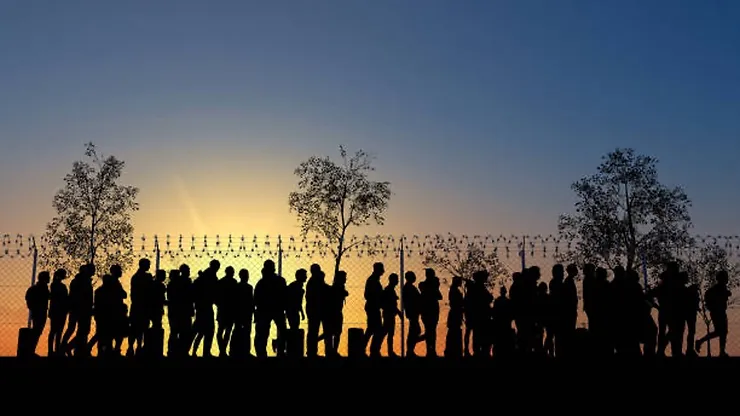
The human crisis comes with staggering numbers, and they rule. By mid-2022, some 103 million people worldwide were forcibly displaced. That included 52.3 million internally displaced in their own countries, 32.5 million refugees outside their home countries, 4.9 million seeking asylum, and 5.3 million “in need of international protection.” (UN Refugee Agency). The UN also estimates that 345 million people live in acute food insecurity (famine at the most extreme) in 82 countries. Easy in the crush to forget each represents a living, breathing, feeling, human being, around half of them children. World Vision, modern evangelical missionaries, offers a heartbreaking estimate of very young migrants. “[A]bout 1.5 million were born as refugees between 2018 and 2021. Many….are likely to remain in exile, some potentially for the rest of their lives.” In online photos, my eyes go to the smallest exiles, carried, hauled, led, by mothers, fathers, older siblings, away from all they’ve known and into the unknown, with no guarantee of safety or survival. Children, smaller, less physically able to get out of the way, are always at greater risk.
Childhood Memories and Dislocation
These images resonate with memories of my road-trip childhood. Not as near the edge: my family rode rather than walked, albeit in an increasingly unreliable Ford. And we had a known destination, routes drawn on gas station roadmaps in pencil or crayon. Highway junctions we were tasked to watch for. We also had the buffering of American immunity, and a home to go back to. But aren’t all children dragged along by their parents’ choices? We could only strap on for the ride to whatever town with a baseball team my dad was managing each summer. In hindsight, I appreciate the chance to sample different communities, to meet folks both alike and different in close-up sharp focus. But getting there often felt confusing, dislocating, made me suspect the adults didn’t have a clue. No motel reservations meant repeat “no room at the inn” nights, with neon “No Vacancy” signs flashing and floating by in what felt like endless darkness. On the positive side, uncertainty may have fueled invention. My sister later described half anticipating that we might sail off into nothingness as the car crested hills. I, in the same car, anchored in wondering about folks who lived in houses and towns we passed. She became an artist; I became a writer/storyteller.
Forced Displacement: A Global Perspective
Causes of war and climate change differ, but both can lead to dislocation, which etches deep into lives new to this world. The documentary film The Mexican Suitcase (2011) “debriefed” adults who’d been very young during the Spanish Civil War. They spoke of constant gnawing hunger and fear, of running and trying to hide when bombs fell—Nazis’ test run for WWII, a la Picasso’s Guernica. And when the cause was lost, exile parents, expecting no mercy, carried and led them across the cold and snow of the Pyrenees to France. Little mercy there either, as emigrants were confined to a bone-chilling, windswept beach, without shelter or facilities, where many died. No wonder desperate families accepted the offer of another crossing, this time over the Atlantic to start again, reinvent and reframe, make “new lives in the new world” of Mexico. The film raises an existential question: Where do exiles belong, if the country they left has ceased to exist [or become unlivable]? And how much of yourself do you leave behind and need to reinvent?
Historical Exile and Endless Roads
Human refugee stories go way back. Consider the Bible and Moses and the Israelites, who escaped the Egyptians and then wandered the desert for 40 years. As for the road itself, the ancient Greek philosopher Zeno devised his Paradoxes to prove that motion was an illusion. Constantly dividing distances in half meant travelers never arrived/reached their goal. Do refugee children ask, “Are we there yet?”
Limbo: Life in Waiting
But how does that apply when “there” typically means refugee camps, where bodies in motion morph into bodies in stasis, not allowed to leave, or work [at least formally] or become citizens of host countries? Sheer numbers make the displaced a problem the world, with UN funding, prefers to shove “out of sight and out of mind.” So, though temporary in theory, in practice, camps look and function as if permanent, can grow to the size of cities, and all the while never appear on official maps.
The Invisible Lives of Child Refugees
For child exiles, these places can become a kind of low-horizon limbo, “open air prisons,” where they grow up, and may become parents, then even grandparents, while they wait, hope, then lose hope. Limbo is a Christian/Catholic concept, a vestibule to heaven, where unbaptized babies were sent. Innocent, but not “washed clean” of original sin, they couldn’t cross the threshold. The idea has always struck me as heartless/heedless cruelty. And who had the authority to say? Refugee’s lives run in harsh parallel. “I hear you knocking, but you can’t come in?” Even harder on those displaced by climate, who still fall into a legal void if they cross national borders. Without standing under international law, they don’t qualify to request asylum. Are these “our people?” Are these “our children?” Are they anybody’s people, anybody’s children?
The World’s Failure to Share Responsibility
Thomas Gray might have referred to child refugees, when he wrote, in his famed Gray’s Elegy [Written in a Country Churchyard] (1750), of “mute inglorious Miltons,” who were “born to blush unseen, And waste… sweetness on the desert air.” The Whitney Houston song The Greatest Love of All comes to mind. “I believe the children are our future; Teach them well and let them lead the way; Show them all the beauty they possess inside; Give them a sense of pride to make it easier; Let the children’s laughter remind us of how we used to be.” But at best, the world offers these children a deferred future. And I think not only of what they themselves lose, but of what we in the world lose by keeping them outside the circle. Consider too the pent-up negative energy created by excluding them. Belonging nowhere, the only way “…[to] survive…[a refugee camp is] imagining a life elsewhere….neither the past, nor the present, nor the future is a safe place for a mind to linger for long….trapped mentally, as well as physically….thoughts constantly flicker…between impossible dreams and a nightmarish reality. In short, to come here you must be completely desperate.” (Ben Rawlence. City of Thorns: Nine Lives in the World’s Largest Refugee Camp.Picador. c2016).
Overcrowded Borders and Collapsing Systems
Amnesty International faults the world community, and “in particular wealthy nations [for] failing to meaningfully share the responsibility for protecting people who have fled their homes in search of safety…[for] failing to agree on and support a fair and predictable system for protecting people forced to leave everything behind because of violence and persecution [and increasingly climate risks].” And again, climate refugees continue to face special challenges even as their numbers increase. In contrast to governments’ delay and denial, big reinsurers, like Zurich Re, which back insurance companies, take a more practical view of climate trends that could cost them billions. In the wake of Hurricane Ida (2021), the premium for my wind and hail policy, through the “only game in town” state insurer, doubled. And, with severe weather events on the rise, that’s happening nationwide. Consequences are even more severe on the “frontlines of the climate crisis” in less resourced parts of the world. “Imagine losing your home or livelihood due to a devastating flood. Going hungry because of a failed harvest or drought. Or being forced to flee your home due to rampant desertification, rising sea levels or a lack of clean drinking water. This is [becoming] reality for millions and millions of climate refugees, for [whom] climate change is real, and… is happening now. And as the threat of climate change increases globally, their numbers will grow exponentially.” (Sean McAllister. There could be 1.2 billion climate refugees by 2050. Zurich Climate Change. January 13, 2023).
Detention Centers and Climate Risks
The US has our own refugee detention centers, many privately run. Countries do try to fend off , shove “out of sight and mind,” the burden massed desperate and destitute people. As of 2020, ICE (US Immigration and Customs Enforcement) held detainees in 128 facilities, often in isolated rural areas. Of these, 72 were “identified as facing significant climate-related risks” likely to grow more severe as climate woes worsen. (Aleen Brown. Migrants fleeing hurricanes and drought face new climate disasters in ICE detention. The Intercept. March 31, 2022). Overcrowding and climate intersect with infrastructure breakdown of water, sanitary, heat and cooling systems, to put desperate people into even greater misery. And the whole rickety system will likely be overwhelmed, even collapse/break down as numbers climb, with the expected surge of some 680,000 peoples across the US-Mexico border between 2021 and 2050 (ProPublica and New York Times analysis. 2021).
Remembering Names, Telling Stories
Circling back to refugee children, I wonder how many in US detention centers house those separated from deported parents or detained after they crossed the border on their own. Countries even leerier of taking on children, who can’t support themselves. So important to say at least some of the names, to tell some of their stories, to not leave all nameless, mere numbers.
· Abdul Sharifu, who froze to death in a Buffalo blizzard, started his refugee journey in 2022 at around age 6, after he lost his parents to war. He then spent 15 years in a refugee camp. Known for his willingness to help, he’d gone out to try to buy milk for a neighbor’s baby. Perhaps, with all he’d survived, he understimated the danger. So, not a happy ending: there are no guarantees on the refugee road. But his child will have been born by now and have the chance to make a life in this country.
· Deborah Veach, a Jewish child Holocaust survivor, spent an extra five years in a displaced persons’ camp waiting to enter this country. A happier ending, and she knows and has lived the refugee’s plight. “…[H]istory keeps repeating itself…Basically we have DPs on our border with Mexico, you have DPs from Ukraine. I don’t think people realize the repercussions for these people who are trying to find a place to live. These are good people who are just placed where they are by history.” (Andrew Sillow-Carroll. UN Exhibit remembers when the world turns its back on stateless Jewish refugees. Times of Israel. January 10, 2023). Amen.