

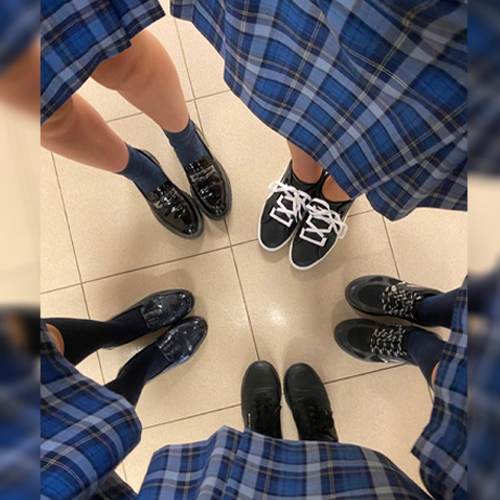
High School Girls and Global Events
Sitting in a coffee shop, I have a gaggle of Catholic high-school girls to one side. Different uniforms but still recognizable. Would other young girls consent to wear matching plaid kilt skirts, white blouses, white school-initialed ankle socks, oxford, or saddle shoes? Energetic, loud, giggling, but not obnoxious about it, my neighbors don’t so much as glance over their shoulders at the TV screen replaying the first Israel airstrikes on Gaza. Meanwhile, though the sound’s off, but I can’t look away from the same scenes on another screen I face. Could this be one of those flashpoint moments when the whole world changes? History can sneak up on us. Seem predictable, transparent as glass in hindsight. Why didn’t we see it coming? Because we’re prone to deny/downplay right up to the shocking moment(s) when the glass shatters, and jagged edges start to draw blood.
Time, Perspective, and Unveiled Stories
We each carry our histories with us, and I was once just such a girl, though in a different uniform. These days, I’m freshly attuned through a storytelling project a friend and I put together with 8th grade/13-year-olds she teaches at a Catholic girls’ school. We have complementary perspectives. She’s profoundly Catholic, schooled by gentle and supportive nuns, while I’m a “recovering Catholic,” who came through grade and high schools under two orders of nuns who seemed to take as given their direct lines to God. But later, a more reasonable set of nuns helped “redeem” my college years and instilled admiration for the church’s going-toward-the-light “social gospel” work. My friend and I consulted to develop about a dozen weekly story prompts focused on helping the girls navigate, “get their minds around,” high school, social media, recent history, the world. We partnered with the girls, who shared story snippets one-on-one, then each told her partner’s story, first-person, to the full class. Our theory was that momentarily “becoming” a classmate could help reduce “mean girl” impulses and build understanding, empathy, respect, community. The girls, game and willing, consistently impressed. Questions bubbled: how much besides the uniforms has changed? What kinds of adults might the girls become and what kind of world will we pass on? Possibilities for human error are endless. Yet, looking at those bright and mostly interested faces, I found many reasons to smile and hope.
Uniforms, Identity and Shaping Lives
Private schools each become their own small worlds. Uniforms unify insiders and separate/differentiate them from outsiders. In my family, we segued from my older sister’s and my boxy forest-green jumpers to my younger sister’s shapeless plaid skirts and blazers. Both paired with saddle shoes I still react against. A historic theory claims a link between unsettled times and shorter skirts. Among our girls, some wear skirts knee length, others hike them higher than our nuns would have accepted. And that could sometimes unpredictably prompt ripping out of hems, regardless of wearer’s embarrassment and loss of sense of agency. But today and at this school, it’s a non-issue. The girls seem much freer in their bodies too, not required to stay in their seats all the time, allowed to chat a bit, not so constrained by “keep your legs crossed” rules. Except for scholarship students, they’re mostly children of privilege, with parents who can afford pricey tuition. Not surprising, with little to fight against, that they appear generally compliant, essentially “mainstream,” yet still so thoughtful at a very young age. The school programs in community service to encourage active participation and growth into women of substance, active in their communities. Will they continue? Will they lean into more questioning? Perhaps even toward a bit of rebellion?
The Evolution of Adolescence
Ideas on adolescence and how to handle those weathering it morph as well. Christianity early designated 7 years as the “age of reason,” the capacity to tell right from wrong. In the Middle Ages, kids from that age up could be executed for a variety of crimes we wouldn’t consider that serious today. My high school’s anthem proclaimed: “Worldliness buffets the stronghold of truth. Be Alma Mater defender of youth.” This seems to echo in present-day agenda that strives to “protect” and “shelter” certain young people—from themselves and their urges and hormones, from uncomfortable historic facts, from sex and “woke” diversity education, from books somebody’s decided deserve banning. But somehow, that protection stops short of finding ways to prevent the physical and emotional trauma of threatened and actual school shootings. And I and my cohorts didn’t have to cope with the immediate, jagged, intrusive, edgy kaleidoscope of social media and the sleazy undertow of bullying, body shaming, grooming. In class discussion, the girls expressed growing interest in boys and reported online exchanges. Sadly, some boys feel empowered to request nude photos. And if that doesn’t work, headlines report AI fake nudes, with real girls’ faces imposed. Not something, as far as I know, my age group ever had to cope with. The girls have watched the film The Social Dilemma, so they’re informed. And they’re still only 13!
Unveiling Edges: Social Media Challenges
The openness of class discussions kept surprising me. We were more talked at, not encouraged to question, to have opinions. A nun once told me I needed to learn to obey more. I only nodded, but knowing myself to be very shy and quiet, figured I’d do better learning to obey at least a bit less. That world felt as if it would last forever, but as we told the girls, ideas move and shift. And the façade was already shaky. Billy Joel foreshadowed some of the downside in his smarmy Only the Good Die Young. “Catholic girls start much too late….Why shouldn’t I be the one?” And the satirist Tom Lehrer may also have felt a chink, lampooning the silliness in Vatican Rag. “The man in the confessional will tell you if your sin’s original.” We’d borrowed the record from the girls next door and my dad, as purist and traditionalist as any nun, made us return it as soon as he heard the words. But too late, with waves of transformation already sweeping in. Starting in 1962, the Vatican II church council began tectonic shifts—vernacular mass in local language, altar facing the congregation, nuns coming out of habit. Priest-altar boy scandals didn’t come to light till later and even now are not fully resolved. Though I did have to go through basic “Safe Environments” certification to work with young girls.
Learning from Past to Present
So, how young is too young to start thinking of serious matters? If each generation has its own tale to discover, live, tell, then trying to force replay of an earlier time is counterproductive, pointless and ill prepares young people to live their own times. And, in delaying introduction of reality to kids, do we also risk infantilizing adults who yearn to go back to more “innocent” times? Recent experience has amply demonstrated chronological age doesn’t automatically equal maturity, ability to cope with frustration, willingness to find effective compromise. (Alex Abad-Santos. People forgot how to act in public. Vox. Aug. 21, 2023). Besides January 6, we hear of folks pitching tantrums on airplanes, throwing stuff (cell phones, bras, underwear) at performers during concerts, talking on phones during movies. (Tina Reid. Public freakouts, burnout, and bullying are all here to stay. Axios. Sep 1, 2023). So, who qualifies as “responsible parties?” When all the big issues feel overwhelming and insoluble? When so-called “leaders” often seem to shy away from even trying? Thinking of Israel-Gaza and Ukraine, I recall an earlier example of what in those Cold War days was called “brinkmanship.” How far can we/they take it? During the Cuban Missile Crisis (1962?), I have a sense memory of walking down a darkened hallway feeling end-of-the-world dread. In the words of Pete Seegar, “When will we [they?] ever learn?”
The Power of Dialogue in the Classroom
Research proves human brains don’t fully mature till the mid-20s. So, our girls are at a delicate, formative, age, yet eager to learn about the world and themselves, in the midst of uncertain times. We calibrated in the story project, striving to balance sampling of knowledge/information/context with support for growing sense of self. I witnessed the process at work in those open discussions curated by skilled and inspired teachers like my friend and a NYC public school teacher I’ve read about. When a student asked if she was “Team Israel or Team Palestinian,” the teacher, herself Jewish, responded that she was “Team Humanity,” and that “she thought both the Hamas terror attacks in Israel and Israel’s ongoing bombing of Gaza are horrific.” (Faith Karimi. A student asked a NYC teacher which side she’s on in the Israel-Hamas war. Here’s what she said. CNN. Oct. 27, 2023). Amen.
Young Activists: Inspiring Change
Meanwhile, at the other end of the spectrum, young activists, many only a bit older than our girls, refuse to be infantilized. Not prepared to wait, they grab hold of their own stories and challenge their elders on critical issues like climate change, even take them to court. Portuguese kids sued 32 governments in the European Court of Human Rights for failing to protect them from the climate crisis. In the US, a judge sided with young environmentalists who sued state agencies for violating their “right to a clean and healthful environment by permitting fossil fuel development without considering its effect on the environment.” (NPR, Associated Press. August 14, 2023; William Brangham. Young Activists in Montana win landmark climate change lawsuit against state. PBS. August 15, 2023). And high-school students of color in a low-income Baltimore neighborhood continue a decade-long environmental justice campaign focused on air quality and small particulates that embed in lungs. They’ve already stopped a giant waste incinerator project and now take on the bigger challenge of stopping a big coal storage/transit station. (B.A. Parker, et al. Student activists are pushing back against big polluters — and winning. NPR. Oct. 4, 2023).
Reflections on the Story Project
On the last day of the storytelling project, we asked the girls to tell us about their perspective on the experience. Most said they liked it. In an earlier time, I might have suspected they meant to please, to tell us what we wanted to hear. But I’d had the chance to sit in on those class discussions. So, I trusted in the accuracy of their reporting. And they told us they appreciated the chance to share, to listen, to learn about classmates. One found “public speaking” easier when she could act as someone else. One wished the project would keep going.
Empathy in Action: Navigating a Complex World
Very gratifying and it strikes me we’re probably asking a lot of the girls only just across the threshold of adolescence. Of course, they’ll focus on immediate, short-term, matters: boyfriends or hopes for them and in another 3 years, driver’s licenses, rite of passage to independence. But two years later, they can they register to vote at age 18. And they’ll will grasp the significance, women in this country having only got the vote around 1920. Going forward, I hope our story project might contribute to the girls’ growing understanding that as humans and social animals, we need each other. But we won’t always get along and that can sometimes degenerate to the extremes of war, too often without an exit strategy. The important thing is to keep talking, listening, sharing stories. A leader of the International Red Cross, speaking to NPR a negotiating Israel-Hamas hostage release, said we don’t have to like each other, we don’t have to agree, but we talk. And I hope our girls might continue to apply their narrative skills to help us “address [our]selves more empathetically to the fears, anxieties, and needs….which no society [and the world] can safely ignore.”(Karen Armstrong. The Battle for God. Knopf. C2000). Amen.